Our statistics for each resort attempt to compare apples to apples. We pour over resort maps and boil it down to 5 important stats.
Real Vertical
This is the actual maximum vertical you can ski without taking another lift, and without walking up hill. Walking on flat-ish terrain counts as long as it’s something people skiing the resort regularly do. It may take multiple lift rides to reach the summit but once you start descending the true vertical will be the end of your run. The bottom of the run must terminate at the base of a lift that makes it possible to repeat the run.
A good example of real vs. published vertical is at Brian Head, UT. The Giant Steps mountain portion has a real vertical of 1,200 ft served by the Giant Steps Express which reaches the highest elevation. The base of Navajo Peak is lower by 120 ft which gives an unrealistic 1,320 ft vertical. You obviously cannot ski the complete vertical in one run because they are 2 completely separate mountains. We report this as 1,200 vertical.
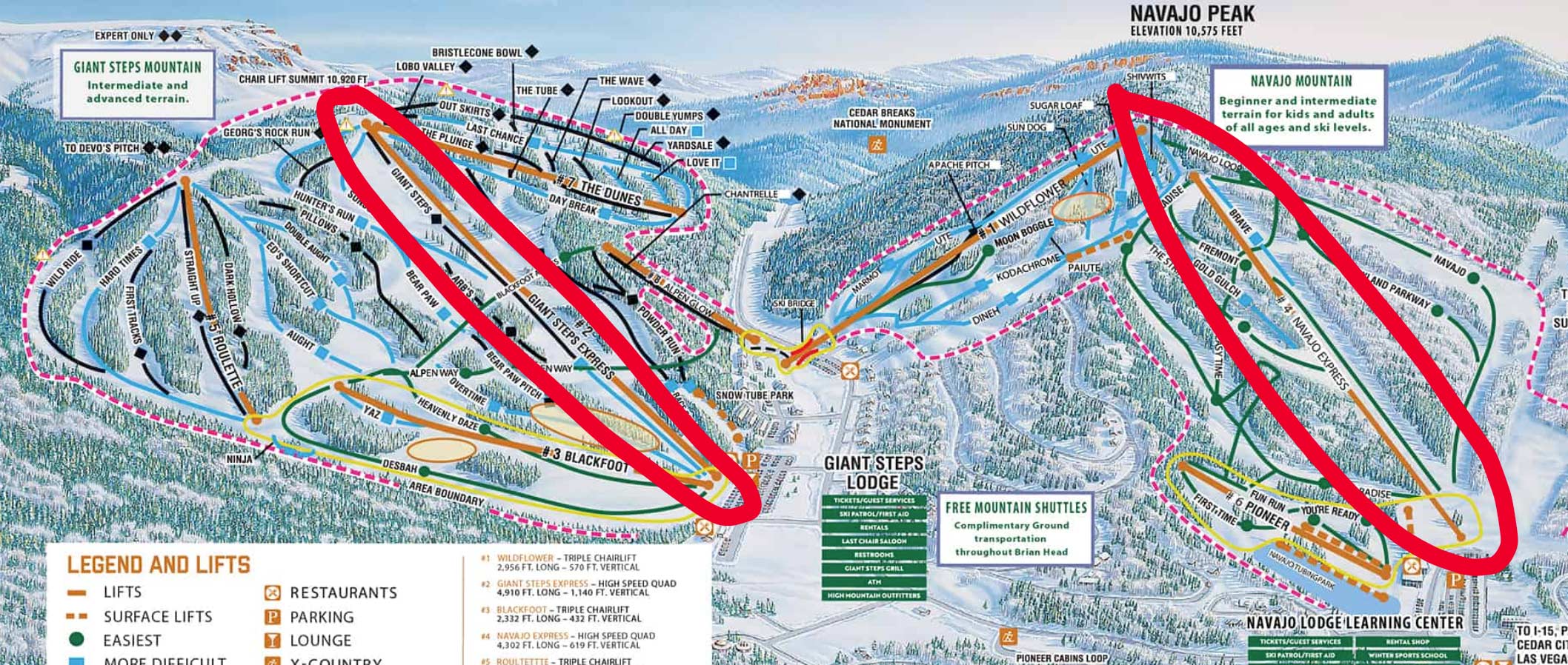
Brian Head Real Vertical
The difference is usually small like in the example above, but in some cases like at Powder Mountain, UT it’s huge. Powder Mountain lists their total vertical at 3,346′ but the true lift-served continuously skiable vertical without hiking is a much smaller 2,100′.
Lift Pods
These are the distinct areas served by individual or multiple lifts. Resorts can double up (or more) lifts next to each other and add them to their official stats, but that doesn’t mean much when you are skiing so we don’t publish those numbers.
Typically people do a few laps in each lift pod and then move on. It makes for a much more interesting experience with more variety.
Here is an extreme example from Mt Snow, Vermont. There is ONE lift pod outlined here, with 11 lifts.
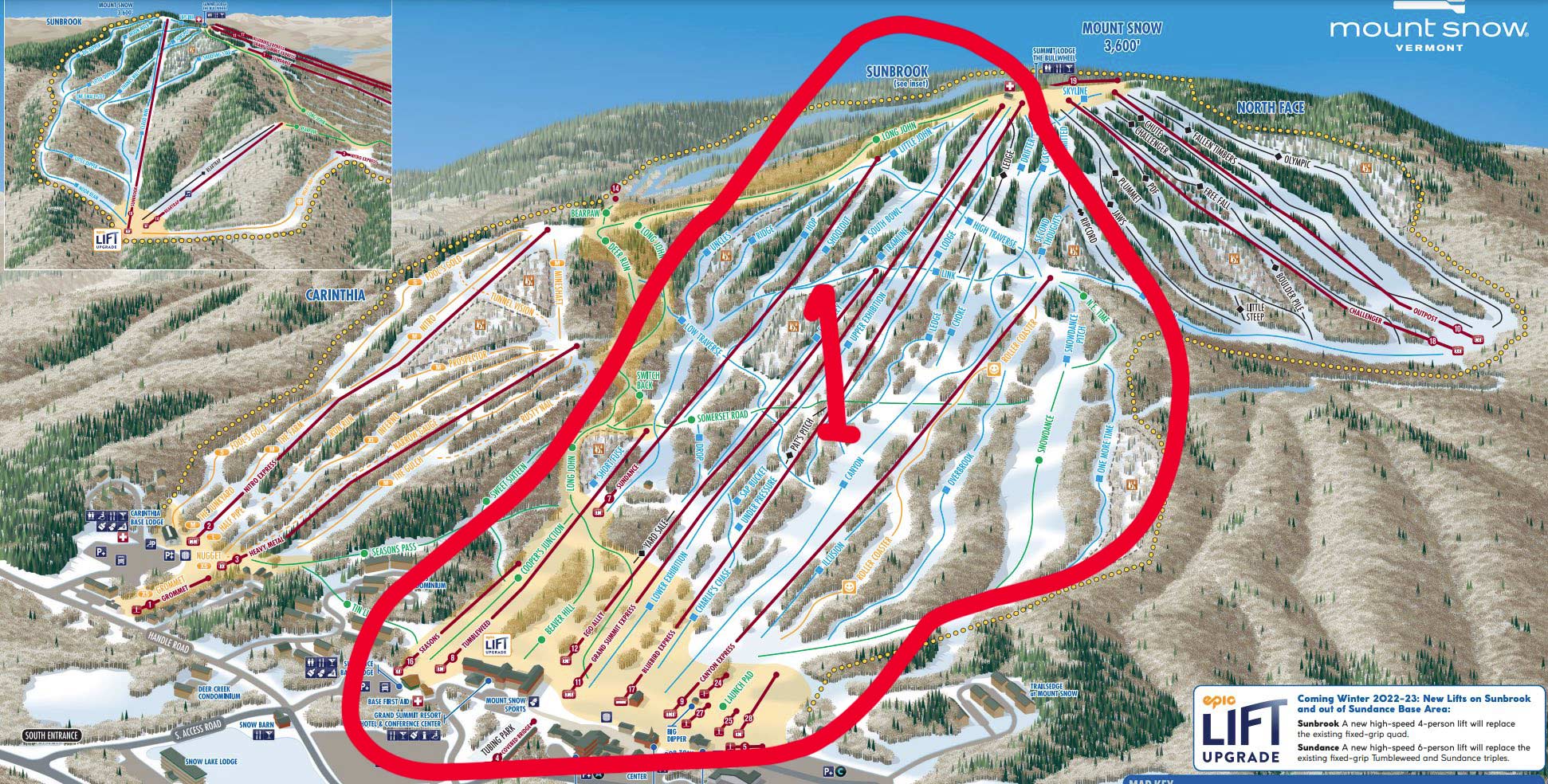
Mt Snow ski pod example
Trails
These are the marketing numbers of trails reported by the resorts. These are usually published on their websites. They can be pretty meaningless. For example, Arapahoe Basin reports 147 trails on only 1,428 acres. This is almost 2X the number of trails reported by Revelstoke, which is more than twice as large. Another example: Heavenly’s trail count increased from 99 to 111 over the past 10-15 years with absolutely no changes or additions to the terrain on the mountain.
We used to attempt to normalize this to make it an even playing field for the rankings. Sometimes resorts break runs down into “Upper”, “Middle” and “Lower” to increase their published trail count or even switch names entirely in the middle of a continuous fall line. This is meaningless and confusing. It’s pretty easy to pick out on a trail map but sometimes you have to ski it to get a true feel for what is a run and what isn’t.
We stopped doing that because it’s just too much of a judgement call on what a distinct trail is. Just know that some resorts exaggerate trail counts for marketing purposes.
Size
This is the published number of acres from the resort. It’s impossible to determine this unless you have the resort master plan documents, so we have to believe the resorts on this one.
Annual Snowfall
This is shown as the resort reported number “claimed” and the number the well respected site ZRankings publishes as their best guess at actual snowfall “actual”. Tony Crocker is a contributor over there and has his own site BestSnow and probably had a lot to do with those numbers. When this is shown in red it is below the average on our list. Green is above average.
| 301″ claimed / 275″ actual, Rank: 68 |
Long ago we made our own attempt to compile these real snowfall numbers but with climate change it became too difficult to keep updating them, and our source OnTheSnow seems to have gotten less reliable at scraping snow reports in the past several years.